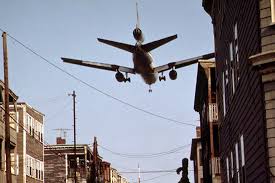
 For the second time in as many weeks, a new study shows dramatic air pollution problems surrounding one of America's major airports. Last week, it was the fact that Particulate Matter was four to five times higher surrounding LAX, adding up to more annual pollution than more than half of the Los Angeles freeway system.
This time, it's Logan in Boston, where an epic, 14-year long effort by the Massachusetts Department of Health and Human Services shows that children living adjacent to the airport suffer respiratory problems at levels as much as four times higher than those who live further from from the runways. Adults living nearby are twice as likely to experience chronic obstructive pulmonary disease than their peers living in more distant Boston neighborhoods.
According to the study's authors, the findings are “statistically significant” and take into account pollution from vehicle traffic and socioeconomic factors such as smoking rates and poverty. It's the first research to try to explore specific health effects surrounding an American airport, relying on interviews with more than 6,000 adults, who also provided health information for more than 2,200 children in 17 communities within a 5-mile radius of the airport.and combined them with advanced air modeling data to estimate exposure to airport-related emissions.
In response, Airport officials and city leaders are working on plans to use more hybrid and natural gas-powered vehicles in and around the airport, including maintenance vehicles and rental cars, as well as requiring planes to use only one engine while taxiing.
DFW Airport long ago required electrification of all ground vehicles because of North Texas' chronic smog problems.
Boston's study was prompted by complaints from residents about pollution and health concerns. The 17 communities within the study area were Boston, Brookline, Cambridge, Chelsea, Everett, Hull, Lynn, Malden, Medford, Melrose, Milton, Nahant, Quincy, Revere, Saugus, Somerville, and Winthrop.